
GPT-5.2 is OpenAI’s newest flagship AI model and the default experience for ChatGPT paid users as of December 2025. Positioned as a major step forward from GPT-5.1, it emphasizes deep reasoning, long-context understanding, and professional knowledge work rather than casual conversation.
This review separates what OpenAI has officially confirmed from what’s been reported by reputable outlets, then explains what GPT-5.2 actually does better — and who should (and shouldn’t) use it.
⭐ At a Glance
- Model: GPT-5.2
- Developer: OpenAI
- Release: December 2025
- Knowledge cutoff: August 2025 (confirmed)
- Positioning: Flagship ChatGPT model for professional and enterprise-grade tasks
- Availability: ChatGPT paid tiers + OpenAI API
Bottom line: GPT-5.2 is the most capable general-purpose AI model currently available for complex reasoning, long documents, and multi-step workflows.
What OpenAI Has Officially Confirmed
GPT-5.2 Is the New Flagship Model
GPT-5.2 replaces GPT-5.1 as the default high-end model in ChatGPT, with automatic routing depending on task complexity. Legacy GPT-5.1 access remains temporarily available.
Multiple Variants for Different Workloads
GPT-5.2 is a model family, not a single release:
- GPT-5.2 Instant — optimized for speed and lightweight tasks
- GPT-5.2 Thinking — balances reasoning depth with responsiveness
- GPT-5.2 Pro — maximum accuracy, consistency, and reliability
This structure mirrors real professional usage: fast answers most of the time, deeper reasoning when stakes are high.
Updated Knowledge Cutoff
All GPT-5.2 variants share a knowledge cutoff of August 2025, making them significantly more current than earlier GPT-5 models.
Stronger Tool & Agent Support
OpenAI documentation confirms improvements in:
- Tool orchestration and chaining
- Iterative code editing via
apply_patch - Shell and command-line execution
- Multi-step task reliability
GPT-5.2 is designed to operate, not merely respond.
What’s Widely Reported (But Not Primary-Source Claims)
Accelerated Release After Competitive Pressure
Multiple major outlets reported an internal OpenAI “code red” in December 2025 amid competition from Google’s Gemini 3 and other frontier models, accelerating GPT-5.2’s release.
Frontier-Scale Context Window (~400K Tokens)
Reports consistently cite extremely large context windows, often around 400,000 tokens, enabling analysis of entire books, contracts, or massive codebases in a single session. OpenAI has not published a hard public limit.
Benchmark Performance Claims
Media coverage relays OpenAI statements that GPT-5.2 exceeds human professional performance across many internal “real-world knowledge work” benchmarks. These should be interpreted directionally, not as guarantees.
Reasoning & Intelligence: The Real Upgrade
The most meaningful improvement in GPT-5.2 is reasoning stability.
Compared with GPT-5.1, GPT-5.2 demonstrates:
- Stronger multi-step causal reasoning
- Fewer mid-analysis logic failures
- Better long-conversation consistency
- Improved self-correction when new information appears
In practice, this results in fewer confident-but-wrong answers and outputs that hold up better under professional scrutiny.
Long-Context & Document Work
GPT-5.2 excels at global understanding across long inputs:
Strengths
- Maintains referential accuracy across very large documents
- Reasons across sections instead of summarizing locally
- Synthesizes multiple documents without losing constraints
Best use cases
- Contract and policy review
- Legal discovery analysis
- Large-scale codebase refactoring
- Research, financial, and operational synthesis
Coding & Technical Work
GPT-5.2 behaves less like a junior helper and more like a senior-to-principal engineer:
- More coherent architectural decisions
- Safer refactors with fewer breaking changes
- More accurate debugging hypotheses
- Stronger tool-assisted workflows
For complex systems work, it is a clear upgrade over GPT-5.1.
GPT-5.2 vs Gemini 3: Practical Differences
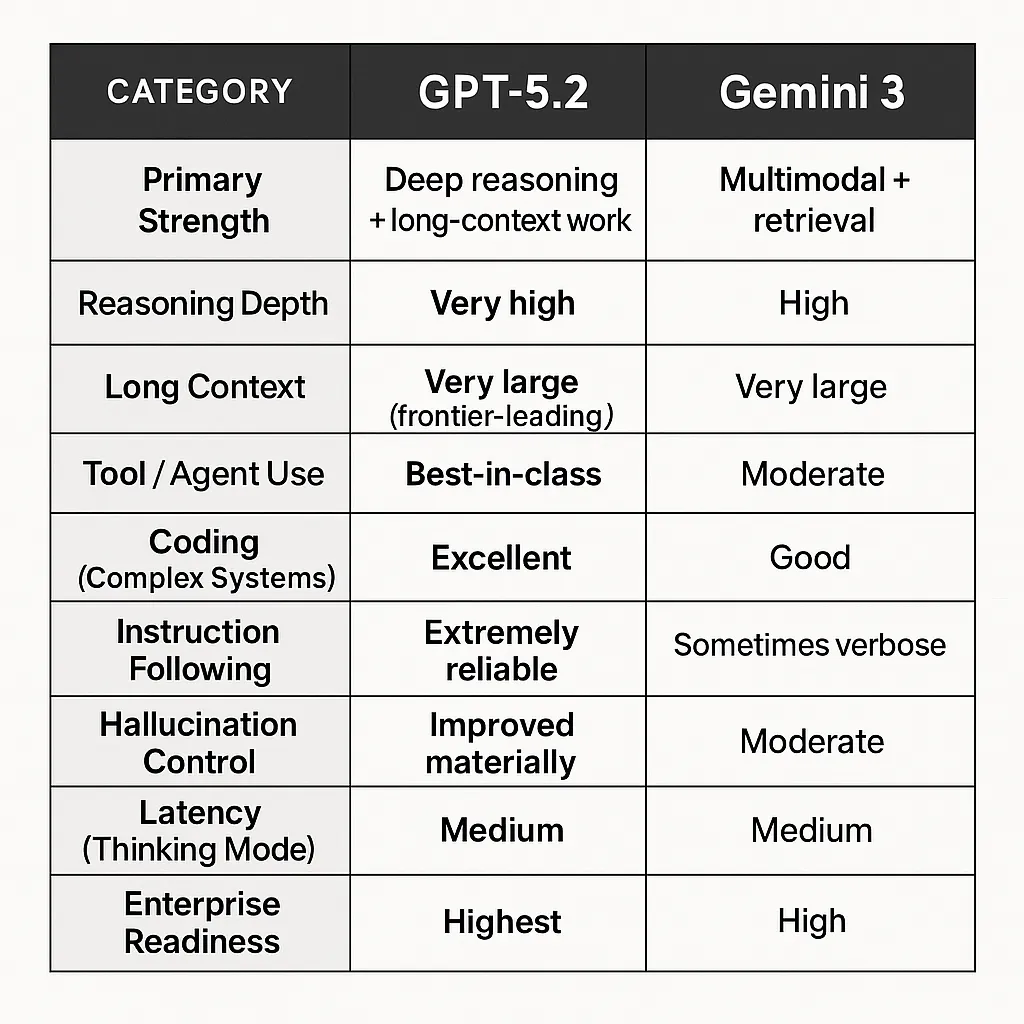
While Gemini 3 shows strengths in specific modalities and integrations, GPT-5.2 consistently delivers more reliable long-form reasoning, better instruction adherence, and stronger agent-style execution in professional contexts.
Agentic Behavior & Workflow Execution
GPT-5.2 is explicitly designed to:
- Plan \n2. Execute \n3. Validate \n4. Iterate \n
This makes it well-suited for:
- Automation pipelines
- Business operations
- IT and DevOps workflows
- Research and reporting systems
Many competing models still function primarily as single-turn assistants.
Reliability, Safety & Control
GPT-5.2 strikes a notable balance:
- Less restrictive than Claude in professional contexts
- More consistent than Gemini in long reasoning chains
- Better-calibrated refusals with fewer unexplained shutdowns
This makes it particularly suitable for enterprise use with human oversight.
When GPT-5.2 Is Not the Best Choice
GPT-5.2 may be overkill if:
- You need ultra-fast, lightweight responses
- Your focus is unconstrained creative writing
- You only require pure factual lookup
Smaller or search-first models may be more efficient in those cases.
Editorial Verdict: Our Current LLM of Choice
After extensive hands-on use, comparative analysis, and real-world evaluation across professional workloads, GPT-5.2 stands out as the best overall large language model we have used to date.
This conclusion is not based on a single benchmark or isolated feature, but on consistent performance across the dimensions that matter most in practice: reasoning depth, long-context coherence, instruction reliability, and the ability to support complex, multi-step work without breaking down.
While other frontier models show strengths in specific areas, GPT-5.2 has proven to be the most balanced, dependable, and adaptable option for serious knowledge work. In our testing, it requires fewer corrective prompts, maintains context more reliably over long sessions, and delivers conclusions that are easier to trust under scrutiny.
For these reasons, GPT-5.2 is the model we are choosing to use going forward, for now, as our primary LLM across research, analysis, and production workflows. As the landscape continues to evolve, we will reassess this decision—but at present, GPT-5.2 represents the strongest overall tool available to us.
Important note:
This assessment reflects our direct experience and expert judgment, not an official industry ranking. Model capabilities evolve rapidly, and future releases may change this conclusion.
Last updated: December 2025
Related reading
- AI Agents vs Chatbots: Difference in 2026
- Protect API Keys in the AI Agent Era (2026)
- Before You Buy: Is Paying for AI Tools Worth It?
The AMA Report cuts through the noise — practical intelligence for business operators making real decisions. Subscribe free →